
Hair Transplant Kuala Lumpur: Your Complete Guide to Hair Restoration
Seeing more hair than usual in your shower drain can feel unsettling. A widening part line or a receding hairline may also affect how you feel about your appearance. This is when hair transplant Kuala Lumpur may come into your mind.
However, hair loss is not only a cosmetic concern. It can influence self-esteem, social confidence, and emotional well-being. For many people, the hardest part is not knowing why the hair is falling out or whether the problem will continue.
Fortunately, you do not have to manage hair loss alone. Modern hair restoration combines medical assessment, proven treatments, and carefully planned surgery. The right approach depends on your hair condition, family history, scalp health, and long-term goals.
If you are considering a hair transplant Kuala Lumpur, choosing the right doctor is an important first step. At Dr. Ruz Hair Transplant, we focus on understanding the cause of your hair loss before recommending treatment. Our approach combines medical knowledge, surgical precision, natural hairline design, and structured follow-up.
This guide explains why hair loss happens, how specialists diagnose it, and what you can expect from medical treatment or hair transplantation.
Understanding How Your Hair Grows
Before discussing hair loss, it helps to understand what happens beneath your scalp.
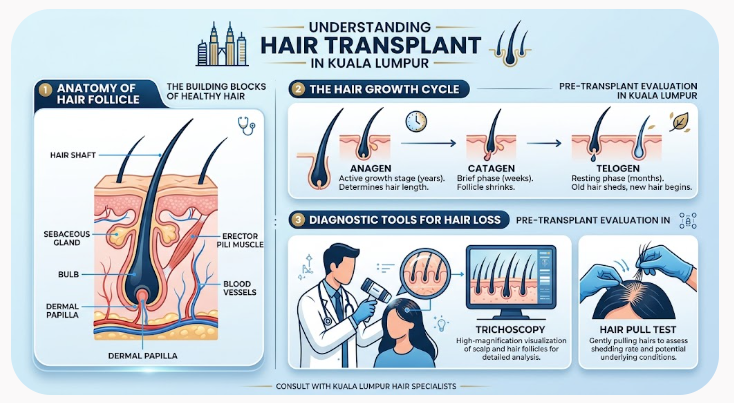
Each hair grows from a structure called a hair follicle. Although it looks small, the follicle is a complex mini-organ. It contains several parts that work together to produce and maintain a hair shaft.
The four main anatomical sections include:
- The hair bulb
- The suprabulbar area
- The isthmus
- The infundibulum
The bulb sits deep inside the scalp. It contains the dermal papilla, which acts as an important control centre for hair growth. This structure communicates with surrounding cells and helps determine the size, strength, and quality of the growing hair.
A healthy scalp usually contains approximately 100,000 to 150,000 hair follicles. Nevertheless, not every follicle grows at the same time. Instead, each follicle follows its own growth cycle.
The Three Stages of the Hair Growth Cycle
First, the anagen phase is the active growth stage. During this period, cells inside the follicle divide rapidly and produce the hair shaft. The anagen phase can last between two and six years in many healthy individuals. At any given time, approximately 85% to 90% of scalp hairs may be in this stage.
Next, the catagen phase is the transition stage. This short phase usually lasts around two to three weeks. During this time, the follicle becomes smaller and gradually separates from its main blood supply.
Finally, the telogen phase is the resting stage. It generally lasts about three months. The old hair remains inside the follicle until it eventually sheds. A new growing hair then begins another cycle.
As a result, shedding is a normal part of healthy hair growth. Most people lose around 50 to 100 hairs each day. However, excessive shedding may occur when too many follicles enter the resting stage at the same time.
That is why a proper diagnosis matters. Hair loss may result from genetic sensitivity, hormonal changes, stress, illness, nutritional problems, or inflammation. Each cause requires a different treatment strategy.
What Causes Pattern Hair Loss?
One of the most common causes of hair thinning is androgenetic alopecia, also known as pattern hair loss.
This condition can affect both men and women. It develops when certain hair follicles have a genetic sensitivity to androgen hormones. The condition often runs in families, although the pattern and severity can vary between individuals.
The Role of DHT
The body produces an enzyme called 5-alpha-reductase. This enzyme converts testosterone into a stronger androgen hormone called dihydrotestosterone, or DHT.
In genetically sensitive follicles, DHT attaches to specific receptors. Over time, this interaction causes the follicle to become smaller. The process is called miniaturisation.
As miniaturisation progresses, thick terminal hairs become:
- Thinner
- Shorter
- Lighter in colour
- Less visible
- More similar to fine vellus hairs
Eventually, some affected follicles may stop producing visible hair.
However, not every area of the scalp responds to DHT in the same way. Hair follicles at the back and sides of the head often show greater resistance to androgen-related miniaturisation. This difference forms the biological foundation of hair transplantation.
Male Pattern Hair Loss
Men commonly notice hair loss around the temples, frontal hairline, or crown. Some experience gradual recession, while others develop thinning at the vertex.
Doctors often use the Norwood-Hamilton Scale to describe the progression of male pattern hair loss. The scale helps identify the current stage and supports long-term treatment planning.
Nevertheless, the scale does not determine your treatment by itself. A doctor must also assess your donor area, hair calibre, scalp condition, age, and future risk of further loss.
Female Pattern Hair Loss
Women often experience a different pattern. Instead of obvious temple recession, they may notice diffuse thinning across the top of the scalp. The frontal hairline often remains relatively preserved.
The Ludwig Scale is commonly used to describe the severity of female pattern hair loss.
Importantly, women may experience several other causes of diffuse shedding. Therefore, a detailed medical assessment is especially important before considering a hair transplant.
Hair Loss Is Not Always Genetic
Although pattern hair loss is common, other conditions can cause sudden or progressive thinning.
For that reason, a reputable hair transplant Kuala Lumpur clinic should not recommend surgery before identifying the likely cause.
Telogen Effluvium
Telogen effluvium causes increased shedding after a significant physical or emotional trigger.
Common triggers may include:
- High fever
- Major surgery
- Severe illness
- Childbirth
- Rapid weight loss
- Crash dieting
- Significant emotional stress
- Certain medications
The shedding often begins two to three months after the trigger. This delay can make the cause difficult to recognise.
During telogen effluvium, many hairs enter the resting phase at the same time. Consequently, the patient may notice large amounts of hair falling during washing or brushing.
Fortunately, the condition may improve after the underlying trigger resolves. However, persistent shedding still requires assessment because another condition may be present.
Alopecia Areata
Alopecia areata is an autoimmune condition. The immune system mistakenly attacks structures involved in hair growth.
The condition often produces smooth, round bald patches. In some cases, it may affect the eyebrows, beard, or other body hair.
Although alopecia areata can be distressing, the follicles are not necessarily permanently destroyed. Therefore, regrowth may remain possible. Treatment depends on the extent and activity of the condition.
Scarring Alopecia
Scarring alopecia requires particular attention. In this condition, inflammation damages the hair follicles and replaces them with scar tissue.
Once a follicle is permanently destroyed, it cannot produce normal hair again. Therefore, early medical assessment is essential.
A person with active scarring alopecia may need medical treatment to control the inflammation before any discussion of transplantation. Surgery is not suitable for every stage of this condition.
How We Diagnose Hair Loss at Dr. Ruz Hair Transplant
At Dr. Ruz Hair Transplant, we believe that good treatment begins with a careful diagnosis.
Instead of starting with a sales presentation, we begin by understanding your concerns, medical history, and hair goals. After that, we assess your scalp and determine which treatment options may be appropriate.
Your Medical History
First, we review important details about your hair loss.
These may include:
- When the shedding or thinning began
- Whether hair loss runs in your family
- Previous illnesses or surgeries
- Stress levels
- Dietary habits
- Weight changes
- Current medications
- Previous hair treatments
- Changes in hormonal health
This information helps us distinguish between temporary shedding and progressive follicle miniaturisation.
Hair Pull Test
During a hair pull test, the doctor gently holds a small group of approximately 50 hairs and applies controlled traction.
If more than 10% of the hairs, or roughly six hairs, come away easily, the result may suggest active shedding. However, the test must be interpreted alongside your medical history and scalp examination.
A hair pull test alone cannot establish a final diagnosis.
Trichoscopy and Scalp Dermoscopy – hair transplant Kuala Lumpur
Trichoscopy uses magnification to examine the scalp and hair shafts in greater detail.
This non-invasive assessment may reveal:
- Differences in hair shaft thickness
- Miniaturised hairs
- Yellow dots
- Abnormal follicular patterns
- Inflammation
- Reduced follicular openings
For example, a loss of follicular openings may raise concern about scarring alopecia. Meanwhile, variation in hair shaft diameter may support a diagnosis of pattern hair loss.
Scalp Biopsy
In unexplained or complex cases, the doctor may recommend a small scalp biopsy.
A 4 mm punch biopsy can provide useful information about the condition of the follicles. The sample may be examined using horizontal sectioning, which allows the doctor to assess follicular units and compare terminal hairs with vellus-like hairs.
This investigation is not necessary for every patient. Instead, it is reserved for cases where additional information may change the diagnosis or treatment plan.
Targeted Blood Tests – hair transplant Kuala Lumpur
Certain blood tests may help identify medical contributors to hair loss.
Depending on your symptoms, the doctor may consider:
- Serum ferritin: To assess iron stores and investigate possible iron deficiency.
- Thyroid-stimulating hormone, or TSH: To check for thyroid-related problems.
- Free testosterone and DHEAS: To investigate possible androgen excess when clinically indicated.
The goal is not to order every test for every patient. Rather, targeted testing helps identify problems that may require treatment before or alongside hair restoration.
Medical Treatments Before Hair Transplantation – hair transplant Kuala Lumpur.
Surgery is not always the first step.
In many cases, medical treatment can help stabilise hair loss, improve the condition of existing follicles, or reduce further thinning. Therefore, a doctor may recommend non-surgical treatment before considering a transplant.
Topical Minoxidil
Topical minoxidil is an evidence-based treatment used for certain types of hair loss.
It is commonly available in 2% and 5% formulations. The treatment works locally on the scalp and may help support the active growth phase of the hair cycle.
However, results vary between individuals. Patients must also use the treatment consistently and follow the doctor’s instructions.
Minoxidil may not be suitable for everyone. Therefore, your doctor should assess your medical history and explain possible side effects before recommending it.
Oral Finasteride
Finasteride is a prescription medicine commonly used for male pattern hair loss.
It reduces the conversion of testosterone into DHT. As a result, it may help slow the miniaturisation process in genetically sensitive follicles.
Finasteride is not appropriate for every patient. The doctor should explain its benefits, limitations, possible side effects, and precautions before treatment begins.
Women who are pregnant or may become pregnant require particular caution with this medication.
Low-Level Laser Therapy
Low-level laser therapy, or LLLT, uses low-intensity red light to support hair growth activity.
Some devices use wavelengths within the red-light range, including approximately 650 to 900 nanometres. LLLT may be considered for selected patients who prefer a drug-free approach or cannot tolerate certain medications.
Nevertheless, it is not a replacement for diagnosis. The treatment works best when the doctor first identifies the cause of the hair loss.
Hair Transplant Kuala Lumpur: Understanding FUT and FUE
When medical treatment cannot restore lost density, hair transplantation may become an option.
An autologous hair transplant uses your own hair follicles. The doctor moves follicles from a donor area to areas affected by thinning or baldness.
Hair from the back and sides of the scalp often has greater resistance to androgen-related miniaturisation. Therefore, suitable transplanted follicles may continue to grow in their new location.
However, the final result depends on several factors. These include donor supply, scalp characteristics, hair calibre, the extent of hair loss, surgical technique, and future hair loss.
FUT Hair Transplant Kuala Lumpur
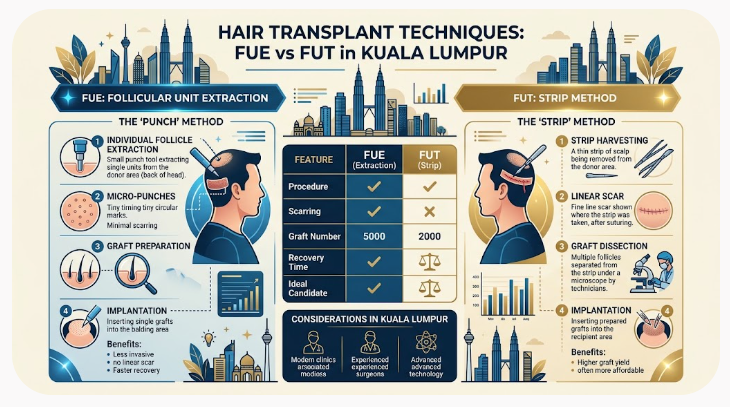
FUT stands for Follicular Unit Transplantation. It is also known as the strip method.
During FUT, the surgeon removes a narrow strip of hair-bearing scalp from the donor area. The surgical team then separates the strip into natural follicular units under magnification.
Each follicular unit may contain one, two, three, or more hairs.
The donor wound is closed using a suitable surgical technique. A trichophytic closure may allow hair to grow through the scar and improve its concealment.
FUT can provide a useful number of grafts in selected patients. However, it creates a linear donor scar. Therefore, the technique may be more suitable for patients who are comfortable with that consideration.
FUE Hair Transplant Kuala Lumpur
FUE stands for Follicular Unit Extraction.
Instead of removing a strip, the surgeon extracts individual follicular units using a small microsurgical punch. Punch sizes commonly range from approximately 0.75 mm to 1.0 mm, depending on the equipment and clinical approach.
FUE does not create one continuous linear incision. Instead, it produces small extraction sites that heal over time. Once healed, the marks may be difficult to notice, although visibility depends on healing, skin characteristics, and hair length.
At Dr. Ruz Hair Transplant, advanced extraction equipment such as the SAFE SCRIBE system may be used to support controlled graft harvesting. The purpose is to reduce unnecessary mechanical damage and protect the follicular units during extraction.
However, no responsible clinic should guarantee a specific graft survival rate for every patient. Graft survival depends on the quality of the donor follicles, extraction, handling, implantation, scalp condition, and postoperative care.
Natural Hairline Design of hair transplant Kuala Lumpur: More Than Just Adding Hair
A successful hair transplant involves more than placing grafts into empty areas.
The doctor must consider facial proportions, age, existing hair, future hair loss, hair direction, and the patient’s natural appearance. Poor planning may create a hairline that looks too straight, too low, or too dense.
At Dr. Ruz Hair Transplant, we pay particular attention to the design of the frontal hairline.
The Snail Track Hairline
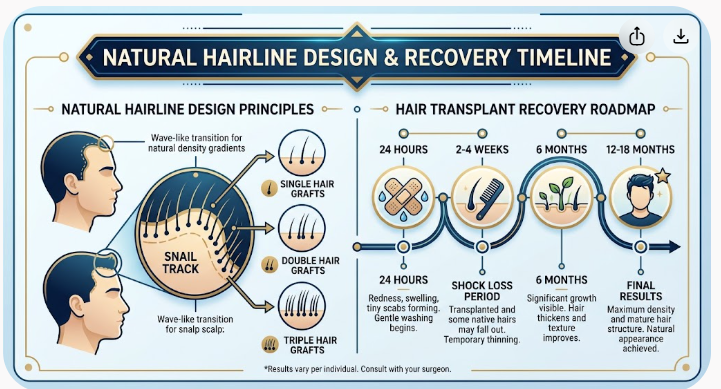
Our approach includes the Snail Track hairline concept. This design follows a soft, irregular, wave-like contour rather than a perfectly straight line.
Natural hairlines rarely look like a ruler. Instead, they contain small variations in height, direction, and spacing.
To create a softer transition, single-hair grafts are generally placed at the front edge. These fine hairs help create a feathered appearance.
Further behind the frontal edge, double- and triple-hair follicular units may provide additional coverage and density.
Direction, Angle, and Spacing
The surgeon must also match the direction of the transplanted hair with the surrounding hair.
Every recipient site requires careful planning. The angle should suit the existing growth pattern, while the spacing should support a natural appearance.
A planning reference of approximately 30 to 50 grafts per square centimetre may be considered in some areas. Nevertheless, the appropriate density varies according to donor supply, scalp characteristics, hair thickness, and the patient’s goals.
More grafts do not automatically create a better result. Good design, correct placement, and long-term planning matter just as much.
What to Expect After a Hair Transplant Kuala Lumpur?
Postoperative care plays an important role in the healing process.
At Dr. Ruz Hair Transplant, we provide structured instructions to help patients protect their grafts and care for the scalp during recovery.
The First 24 Hours
During the first day, the newly implanted grafts require gentle handling.
Avoid unnecessary touching, rubbing, scratching, or pressure on the recipient area. Button-down shirts or zippered tops may make dressing easier because they reduce the need to pull clothing over the scalp.
Gentle Hair Washing
Our clinic provides the first medical hair wash approximately 24 hours after surgery.
At home, patients may be instructed to wash the scalp daily using cooled boiled water and diluted baby shampoo, according to the clinic’s postoperative protocol.
Gentle washing helps remove fluid, scabs, and debris. It also reduces the risk of thick crust formation.
Always follow the specific instructions provided by your surgical team because postoperative protocols may differ between patients.
Temporary Shock Loss
Some patients experience shedding two to four weeks after surgery.
This process is commonly called shock loss. The transplanted hair shaft may shed while the follicle remains beneath the skin.
Therefore, shedding during this stage does not automatically mean that the transplant has failed. New growth often begins around three to four months after surgery, although the timing varies.
When Will You See Results after hair transplant Kuala Lumpur?
Some improvement may become noticeable around six months. However, hair growth continues gradually.
The final maturation of transplanted hair often takes approximately 12 to 18 months. During this period, the hair may become thicker, stronger, and easier to style.
Patience is essential. Hair transplantation is a biological process, not an instant cosmetic procedure.
Why Choose Dr. Ruz Hair Transplant of hair transplant Kuala Lumpur?
Choosing a hair restoration clinic is an important decision. The right clinic should provide clear information, realistic expectations, careful diagnosis, and appropriate follow-up.
At Dr. Ruz Hair Transplant, we do not believe in high-pressure sales tactics or unrealistic promises. Instead, we focus on helping patients understand their condition and make informed decisions.
Our approach includes:
- Doctor-led assessment
- Personalised treatment planning
- Evidence-based medical options
- Careful donor-area evaluation
- Natural hairline design
- Surgical precision
- Patient comfort and safety
- Structured postoperative care
- Long-term follow-up in Malaysia
We hair transplant Kuala Lumpur also believe that hair transplantation should not be viewed in isolation. Existing hair may continue to thin after surgery. Therefore, medical treatment and nutritional optimisation may form part of a broader hair restoration plan when appropriate.
Our goal in hair transplant Kuala Lumpur is to support both your transplanted hair and your remaining natural hair.
Most importantly, we want you to understand the process before making a decision.
Take the First Step Towards Hair Restoration in hair transplant Kuala Lumpur.
Hair loss can affect how you see yourself. Nevertheless, the right treatment can begin with a simple and informed conversation.
If you are experiencing a receding hairline, crown thinning, diffuse shedding, or progressive baldness, an early assessment may help clarify your options.
Whether you need medical treatment, further investigation, or a carefully planned hair transplant, Dr. Ruz Hair Transplant can guide you through the next step.
Are you considering a hair transplant Kuala Lumpur?
Visit drruzhairtransplant.com to arrange a personalised consultation with Dr. Ruz Hair Transplant.
Together, we can assess your hair loss, understand your goals, and create a structured treatment plan designed around your needs.
Because your confidence determines your future.